中文
中文 English
 Spanish
 Arabic


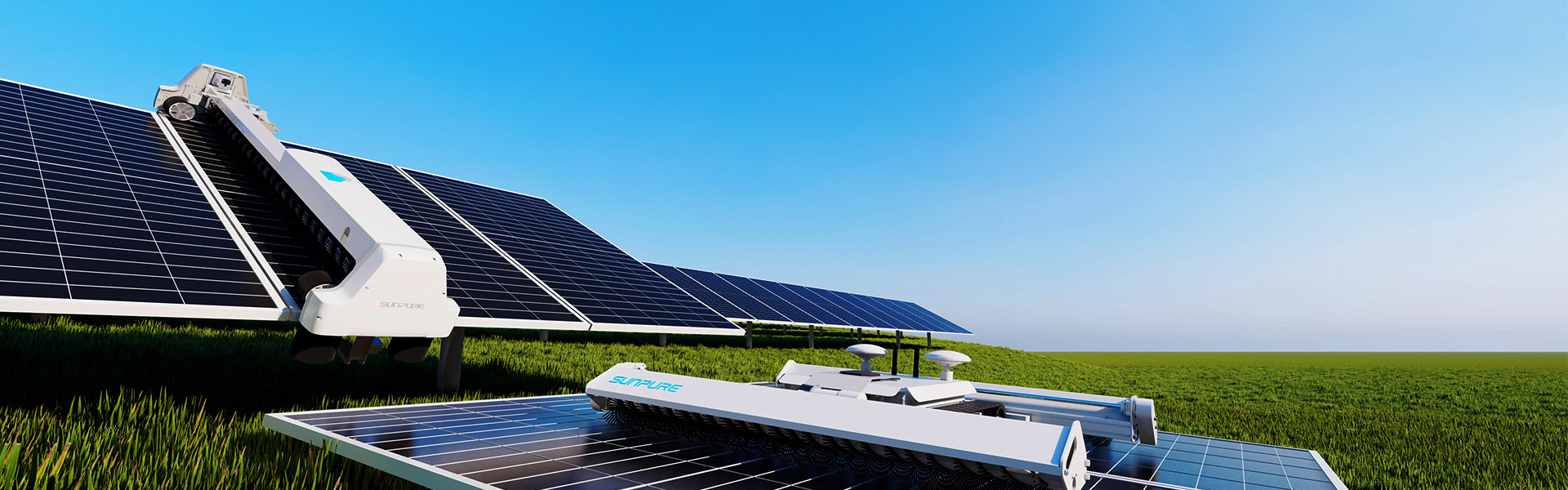





As power station operation and maintenance become increasingly intelligent, we are seeing more and more cleaning robots appearing in various photovoltaic power stations, including ground-mounted and distributed systems. Robots have become the “good partners” of photovoltaic modules, helping clean dust from the modules every day to keep them constantly clean. But are robots truly friendly enough to the modules?
As power station operation and maintenance become increasingly intelligent, we are seeing more and more cleaning robots appearing in various photovoltaic power stations, including ground-mounted and distributed systems. Robots have become the “good partners” of photovoltaic modules, helping clean dust from the modules every day to keep them constantly clean. But are robots truly friendly enough to the modules? In today’s mini-class, let’s take a closer look:
During the long-term operation of photovoltaic power stations, what impacts does dust pollution have on modules?
Shading Effect: Dust on the surface creates a shading effect on solar cells, reducing the solar irradiance received by the panels and resulting in power generation losses;
Temperature Impact: Dust coverage increases the thermal resistance of the module surface, affecting heat dissipation. For every 1°C increase in module temperature, output power decreases by approximately 0.4%;
Hot Spot Effect: Stubborn stains can easily form hot spots on the module surface, affecting power generation and increasing safety risks;
Chemical Corrosion: When acidic or alkaline dust remains on the module surface for a long time, it gradually corrodes the glass surface, forming pitting. This causes diffuse reflection of light when sunlight enters the module surface, reducing the actual solar energy reaching the cells, thereby lowering power generation and shortening module lifespan;
Therefore, the most direct impact of dust on modules is reduced power generation, increased levelized cost of electricity, and potential threats to module lifespan and power station safety.
How much will power generation efficiency decrease if modules are not cleaned?
Without cleaning, module power generation efficiency decreases at an average rate of about 1% per day, and the maximum recorded efficiency drop globally has reached as high as 70%. Therefore, regular cleaning of modules is especially important.
What cleaning methods are currently available on the market?
There are currently three main cleaning methods: manual cleaning, vehicle-based cleaning, and fully automated dry cleaning. The first two methods require water, offer low levels of intelligence, and cannot guarantee cleaning effectiveness.
Fully automated dry cleaning is an emerging cleaning mode in today’s market. Its features of full automation, easy maintenance, and high cleaning frequency are favored by most plant owners. At the same time, minimizing module power degradation caused by coating wear during the cleaning process is an issue that deserves serious attention.
How is the impact of photovoltaic module cleaning robots on modules tested?
A simulated mounting structure and photovoltaic modules are installed as a testing platform. The cleaning robot performs repeated cleaning cycles on the platform. Based on one cleaning cycle per day, a 30-year lifecycle equals approximately 20,000 cleaning cycles. During and after the test, EL and IV inspections are conducted on the modules.
EL testing places the solar panel in a dark environment and applies a constant DC current. Based on the photoelectric conversion principle, the panel emits infrared light. A CCD camera is placed in the dark area to capture images, allowing inspectors to directly observe panel quality on a screen. Although inspectors cannot see infrared wavelengths in the darkroom, the images are clearly displayed on the monitor.
IV testing uses a Class A solar simulator compliant with IEC 60904-9 requirements to determine the current-voltage characteristics of the module under specific irradiance and temperature conditions, thereby identifying power degradation caused by robot operation on the module surface.
Robots that are more module-friendly will not cause micro-cracks throughout the entire lifecycle, and the total power degradation will remain below 2.5%.
What impact do Renjie photovoltaic module cleaning robots have on modules during cleaning?
Recently, Renjie Intelligent jointly conducted compatibility tests with a leading module manufacturer and a single-axis tracker supplier. The test results showed that Renjie cleaning robots are extremely friendly to modules over a 30-year lifecycle, with total module power degradation of only about 1%, indicating minimal impact on the modules.
This is mainly attributed to the brush design and manufacturing process of Renjie Intelligent’s PR200 series robots. The robots adopt a unique spiral brush structure that precisely controls airflow generated by brush rotation, allowing dust to fall off more easily during cleaning. Meanwhile, the brush bristles are made of advanced polymer materials. Through hundreds of tests optimizing bristle diameter, compression, and planting density, the optimal combination was achieved. While maintaining cleaning efficiency, damage to modules is minimized to the greatest extent possible.
Have you grasped these key points about the perfect “CP” combination of cleaning robots and photovoltaic modules?